
Analysis · Analysis
What 1 million beta characters tell us
A dated look at the October 13 fan census: class and race shares, the opposing faction's toolkit, Skyborne's effect and the very different duel sign-up field.
 WoW Forever TavernCoverage 14 Oct 2026 · 5 min read
Coverage:
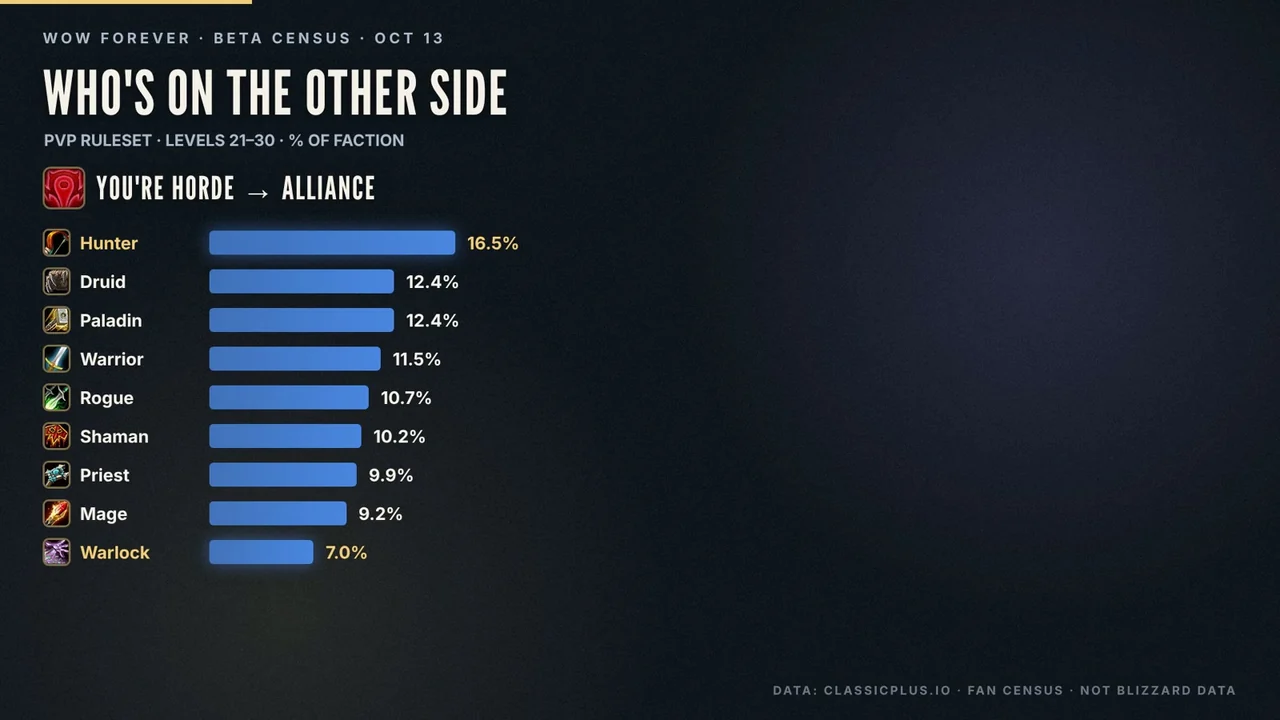
Based on the October 13, 2026 ClassicPlus.io fan census and that day's community tournament tracker. Character scans are not player counts, a live server population or a forecast of launch.
A million characters does not mean a million players
The beta fan census passed 1 million recorded characters in the October 13 snapshot. It is a useful view of scanned characters, but its coverage depends on people scanning and uploading. One player can have several characters, and a recorded character need not be online, active or planning to keep the same choice at launch.
The finished episode uses levels 21–30 for its main comparisons. That removes the old level 20 cap, where 86,268 characters were still listed, and leaves 314,816 characters across both rulesets. For faction comparisons, it narrows again to PvP. Mixing the whole census, the upper-level sample and the PvP subset would change the denominator and produce misleading percentages.
CHARACTERS, NOT PLAYERS
Community scans and uploads; not official Blizzard population data.
Who appears on the other side?
In the PvP level 21–30 sample, Hunter is the largest Alliance class at 16.5%, while Shaman leads Horde at 14.9%. Warlock is the smallest Alliance class at 7.0%; Mage is the smallest Horde class at 7.4%. These are shares within the named faction, not shares of the whole beta.
Race changes the picture too. Humans account for 30.9% of the Alliance subset, while Undead account for 34.3% of Horde. Rogue appears more often on PvP than on the Normal ruleset in the same level range: approximately one character in nine versus one in thirteen.
These numbers help describe likely tools in the sample. They do not establish that one faction is stronger, that every character is equally active in world PvP, or that your encounters will be a random draw from the census.
| PvP, levels 21–30 | Alliance share | Horde share |
|---|---|---|
| Hunter | 16.5% | 13.8% |
| Shaman | 10.2% | 14.9% |
| Warlock | 7.0% | 9.2% |
| Mage | 9.2% | 7.4% |
A Rogue's preparation starts with different tools on each faction
Humans, Dwarves and Hunters together make up 57.3% of Alliance PvP characters in this range. That is a union of overlapping categories, not three percentages added without checking duplicates. For a Horde Rogue, the relevant tools include Perception's increased stealth detection, Stoneform removing poisons and bleeds, and Hunter's Mark allowing the Hunter to see the marked target through stealth.
Perception is not guaranteed detection, and this calculation does not claim a Rogue loses to every character in the group. Humans also have a stun break, while Mages have Blink. Human-or-Mage accounts for 38.3% of the Alliance sample, illustrating a different overlapping set of tools.
An Alliance Rogue faces another combination. Orc, Tauren or Hunter together accounts for 43.79% of Horde in the range. Hardiness shortens stuns, War Stomp supplies a nearby stun, and Hunters carry the same Mark. The practical use is knowing which ability may matter before committing to a fight.
Sources: ClassicPlus.io fan census, October 13 snapshot · Talents Forever spellbook and talents, CC BY 4.0; episode build 70291
Fear answers and Shaman tools need precise reading
Undead, Priest, Shaman or Warrior together forms 61.33% of Horde PvP characters in the sample. Priest, Shaman or Warrior forms 31.65% of Alliance. The abilities behind those categories do different jobs: Will of the Forsaken removes Fear, Fear Ward protects against the next Fear, Tremor removes effects from nearby party members, and Berserker Rage provides immunity under its own conditions.
Those shares count races and classes with potential Fear answers, not characters currently immune to Fear. In the episode's data, Berserker Rage is learned at level 30, so Warriors below 30 in this level 21–30 sample do not yet have it. Cooldowns, positioning and actually using each ability also matter. The census does not record the outcome of a Warlock encounter.
For Alliance casters, Horde's large Shaman share makes Purge, Earth Shock and Grounding worth understanding. Purge removes magic buffs; Earth Shock interrupts; Grounding can intercept a harmful single-target spell under its rules. Horde casters face fewer Shamans in this sample, and Alliance Shamans are Dwarves. These are toolkit observations, rather than measured combat advantages.
Sources: ClassicPlus.io fan census, October 13 snapshot · Talents Forever spellbook and talents, CC BY 4.0; episode build 70291
Why removing Skyborne changes the class order
Skyborne makes up 18.7% of the entire census. Within levels 21–30, 51.0% of Druids are Skyborne. Removing all Skyborne characters from that range would move Druid from 12.2% of the sample to 7.3%, holding every other recorded choice fixed.
That is a sensitivity test, not a launch prediction. It does not say Skyborne players will disappear, that they will choose another class in particular, or that paid access caused every observed difference. It shows how much a class share can depend on which characters are present in the sample.
The same caution applies to changes since September 29. Newly added PvP scans give Druid a larger share on both factions and Mage a smaller one, while Paladin grows more on Horde. Added records are not a direct account of individual players rerolling.
The duel sign-up field is a different population
An October 13 community tracker listed 2,276 level 30 sign-ups for the Forever Open. Compared with Horde level 30 PvP characters in the census, Priest was much more common in the tracker and Warrior less common. Within tournament Shamans, about 77% were Orcs, compared with under 40% of Horde Shamans at level 30 in the census.
Skyborne was only about 1.7% of those sign-ups, against 16.5% in the matching census subset. Druid initially looked rarer in the tournament, but removing Skyborne from both groups brought its shares much closer: 6.5% versus 6.8%.
A self-selected duel field follows different incentives from a broad beta census. The tracker was unofficial and its method was not described. Sign-ups also are not the final checked-in competitors. Use the comparison to see selection effects, not to turn tournament representation into a universal class ranking.
CENSUS ≠ DUEL FIELD
Horde, PvP, level 30 characters.
Community-tracked level 30 sign-ups on October 13.
Different samples and incentives; sign-ups are not final attendance.
Sources: ClassicPlus.io fan census, October 13 snapshot · Official tournament format; sign-up counts come from the separately identified community tracker
Use the snapshot to prepare, then choose what you enjoy
The useful result is a shortlist of tools to understand: detection and stun breaks for a Rogue, Fear counters for a Warlock, Shaman utility for a caster, and Hunter control for many opponents. The class journals and talent calculator provide the next step when you want the actual ability or prerequisite.
Keep the snapshot date beside the numbers. Future scans, access changes and player choices can alter the mix. None of this substitutes for trying the class you want to spend time playing.
TAKE IT INTO THE GAME
Keep exploring
Sources & further reading
Episode reporting, original gameplay and the source material behind this article. Coverage dates distinguish older announcements from later updates.
- ClassicPlus.io fan census, October 13 snapshot ↗
- Talents Forever spellbook and talents, CC BY 4.0; episode build 70291 ↗
- Official tournament format; sign-up counts come from the separately identified community tracker ↗
Written by WoW Forever Tavern. Game names, artwork and footage © Blizzard Entertainment.
MORE FROM THE TAVERN
Related reading
 Analysis
PvP
Forever Open finals preview: what the qualifiers say about which class could win $50,000
Who qualified for The Forever Open finals, which talent trees they brought, spec-against-spec records from every Swiss round, the opening draw and our pick.
 Analysis
PvP
Our Forever Open tier list: all 27 specs ranked for level 30 duels
WoW Forever Tavern's pre-tournament ranking of every spec for The Forever Open, with the reasoning behind each tier, our pick to win and our dark horse.
 News explained
PvP
The $100K Forever Open rules explained: prizes, Swiss, finals and the October 14 banned list
How The Forever Open's $100,000 was split, why qualifiers ranked players against their own class, how the finals bracket worked and which items the October 14 update banned.