
News explained · PvP
The $100K Forever Open rules explained: prizes, Swiss, finals and the October 14 banned list
How The Forever Open's $100,000 was split, why qualifiers ranked players against their own class, how the finals bracket worked and which items the October 14 update banned.
 WoW Forever TavernCoverage 16 Oct 2026 · 6 min read
Coverage:

Reflects the official tournament documents as checked on October 14, 2026, before the October 17 qualifiers. The organizers later published revised finals rules on October 18; the differences are noted in the finals section. Results are not covered here.
The money and who was allowed to play
The Forever Open put $100,000 on level 30 duels on the WoW Forever beta: qualifiers on Saturday, October 17, finals on Sunday, October 18. The champion's share was $50,000; the other $50,000 was divided evenly across the 9 classes, about $5,555 for the best finisher of each.
Nobody could be paid twice. If the champion also finished first in their class, that class prize passed to the next-best player of the same class. If two players shared the top of a class, they split it.
Every competitor played Horde on the PvP ruleset, on a new level 30 character with the last name Foreverpvp; registration had closed on October 2. Saturday opened with a one-hour check-in from 7 to 8 AM Pacific, with no late entries. Each player paid a 15 gold entry fee and locked one character and one talent build for the day. Qualifiers were scheduled for 10 AM Pacific.
Sources: Official Rules, Regulations & Code of Conduct: prize pool, registration, broadcast · Official Qualifiers & Finals Format and Rules (checked October 14)
Saturday: pods, six Swiss rounds and a ranking by class
Players were split into pods of around 36, each with a class mix similar to the whole field. Every pod played 6 rounds of Swiss, which pairs players with similar records. A win was worth 3 points, a tie 1 and a loss 0, so 6–0 was worth 18. Nobody was eliminated during the Swiss, and a duel that ran out the game's own timer was a tie with no replay.
The important detail is that pods only decided who played whom. The ranking that mattered was by class, across every pod. Every Mage was compared with every other Mage in the qualifier, and the top 4 of each class advanced: 9 classes, 4 places each, 36 finalists.
Ties were broken in order. More wins came first. Next was Buchholz, which adds up the final points of everyone a player faced, so a harder schedule ranks higher. If that still could not separate them, the players met in a same-class tiebreak duel, which could not end in a tie.
PODS PAIR. CLASSES RANK.
Win 3 points, tie 1, loss 0. A qualifier timeout was a tie with no replay.
Sources: Official Qualifiers & Finals Format and Rules (checked October 14)
Sunday: the double-elimination finals
The finals used one double-elimination bracket seeded by Saturday's results. The 8 lowest seeds opened in a play-in round whose losers dropped to the lower bracket. Upper bracket matches were best of 3; under the October 14 documents every lower bracket match was a single duel. The grand final was best of 5 with no bracket reset, and its winner took the title Death's Duelist.
Finalists were also to lock in a second talent build overnight. Between duels players had at most 1 minute to eat, drink and change gear, and nobody could delay a finals duel to wait for cooldowns, so a major cooldown used in game 1 could still be down in game 2. A timed-out finals duel was replayed, and each player could then use only 3 food and 3 water for the rest of that match.
The revised Finals Rules dated October 18 changed some of this. No locked finals build applied; instead players could not change talents once summoned to the dueling area. The Lower Final became best of 3. A timed-out finals duel triggered a Sudden Death replay, in which Goblin Sapper Charges were permitted, with the same 3 food and 3 water limit for the rest of the match.
Sources: Official Qualifiers & Finals Format and Rules (checked October 14) · Official Finals Rules dated October 18, published after this episode
The banned list after the October 14 update
Banned items could not be equipped for a match or be present in a player's bags during inspection, and admins checked bags on stream before each duel. The original list named Goblin Sapper Charge, Flash Bomb, Magic Dust, Slumber Sand, the Furbolg Medicine Pouch, Student Fodder,  Truthseeker's Bow and Green Whelp Armor. Truthseeker's Bow no longer appeared in the updated Guidelines but remained in the Format Rules, which take priority.
The October 14 update to the Guidelines added five items: Deviate Fish, Green Leaf Tea, the Minor Magic Resistance Potion, the Crystal Basilisk Spine and the Gnomish Mind Control Cap. Green Leaf Tea is written as the Guidelines spell it; we could not match that name to an item in the game client. The update also banned quest and dungeon rewards above item level 45, and profession items and tools requiring 226 skill or more.
Also banned: all 6 protection potions, damage-dealing pet summons from non-equippable items such as Spider Swarm, holiday buffs and consumables, and campfire, world and quest buffs such as the Blood Shard buffs. A violation could mean disqualification.
Unbanned consumables were allowed, including Free Action Potions and permitted grenades, as were Legacy points and equippable pet trinkets such as the Dog Whistle. Players could buff themselves with their own class buffs and items, but not take buffs from other classes.
Sources: Official Tournament Guidelines, October 14 revision: banned items and openers · Official Qualifiers & Finals Format and Rules (checked October 14)
How every duel starts: positions, openers and class rules
Both players started on the duel flag, walked 10 yards in opposite directions and ended 20 yards apart. Nobody moved before the duel began unless they were stealthed. Pets stayed at their owner's side until the duel began and the opponent turned hostile. The admin counted down from 10 and both players accepted.
Stealth classes always received the opener, and for this rule Druids counted as stealth. Warriors did too, except against a stealth class. The opener is the first offensive action, such as Cheap Shot, Charge, a permitted grenade or Blood Fury. Until it was used or expired, 25 seconds after the opponent turned hostile, the other player had to stand still: no turning, and no Hunter traps. A Druid opening with a cast such as Entangling Roots ended the protection when the cast began. Two Warriors had no opener, two stealth classes had to find each other, and without a Rogue, Druid or Warrior nobody had one.
Some rules targeted single classes. Pre-HoTs were banned, though Priests could start with Power Word: Shield. Hunter traps waited for the countdown to reach 0 and the opponent to turn hostile. Warlocks could not sacrifice their demon early. Shamans could have up to 4 totems down at the start, except totems that would break a stealth or Warrior opener; those waited until the opener was used.
Sources: Official Qualifiers & Finals Format and Rules (checked October 14) · Official Rules, Regulations & Code of Conduct: prize pool, registration, broadcast · Official Tournament Guidelines, October 14 revision: banned items and openers
The small rules that could decide a duel
Each player had a 3-minute away allowance per stage, renewed on Sunday. A genuine disconnect usually meant a restart if the player returned in time, while the clock kept running. Once the allowance was gone, a missed duel was lost.
Players stayed in the tournament area, with no bank, mailbox or vendor visits; after the October 14 update Warlocks also stayed and followed admin instructions for Soul Shards. Sixty seconds of inactivity during a duel was delay of game, and stalling for a timeout could be penalized instead of scored as a tie. Deliberately running out of a duel could cost the duel or mean disqualification, and a player who deliberately chain-Feared an opponent over the duel line could be penalized. Impersonating an admin could also mean disqualification, and admin decisions were final.
Transmog was off, and every player streamed their own point of view and kept the VOD. The main broadcast ran on Esfand's and Xaryu's Twitch channels on both days.
Sources: Official Qualifiers & Finals Format and Rules (checked October 14) · Official Rules, Regulations & Code of Conduct: prize pool, registration, broadcast · Official Tournament Guidelines, October 14 revision: banned items and openers
WATCH THE EPISODE
The $100K WoW Forever Open: Every Rule Explained (Oct 14 Update)
The $100K WoW Forever Open: Every Rule Explained (Oct 14 Update)
After loading, YouTube’s privacy policy applies. Privacy policy ↗
Open on YouTube ↗WoW Forever Tavern · published 16 Oct 2026 · Watch on YouTube ↗
TAKE IT INTO THE GAME
Keep exploring
Sources & further reading
Episode reporting, original gameplay and the source material behind this article. Coverage dates distinguish older announcements from later updates.
- Official Qualifiers & Finals Format and Rules (checked October 14) ↗
- Official Rules, Regulations & Code of Conduct: prize pool, registration, broadcast ↗
- Official Tournament Guidelines, October 14 revision: banned items and openers ↗
- Official Finals Rules dated October 18, published after this episode ↗
Written by WoW Forever Tavern. Game names, artwork and footage © Blizzard Entertainment.
MORE FROM THE TAVERN
Related reading
 Analysis
PvP
Forever Open finals preview: what the qualifiers say about which class could win $50,000
Who qualified for The Forever Open finals, which talent trees they brought, spec-against-spec records from every Swiss round, the opening draw and our pick.
 Analysis
PvP
Our Forever Open tier list: all 27 specs ranked for level 30 duels
WoW Forever Tavern's pre-tournament ranking of every spec for The Forever Open, with the reasoning behind each tier, our pick to win and our dark horse.
 Analysis
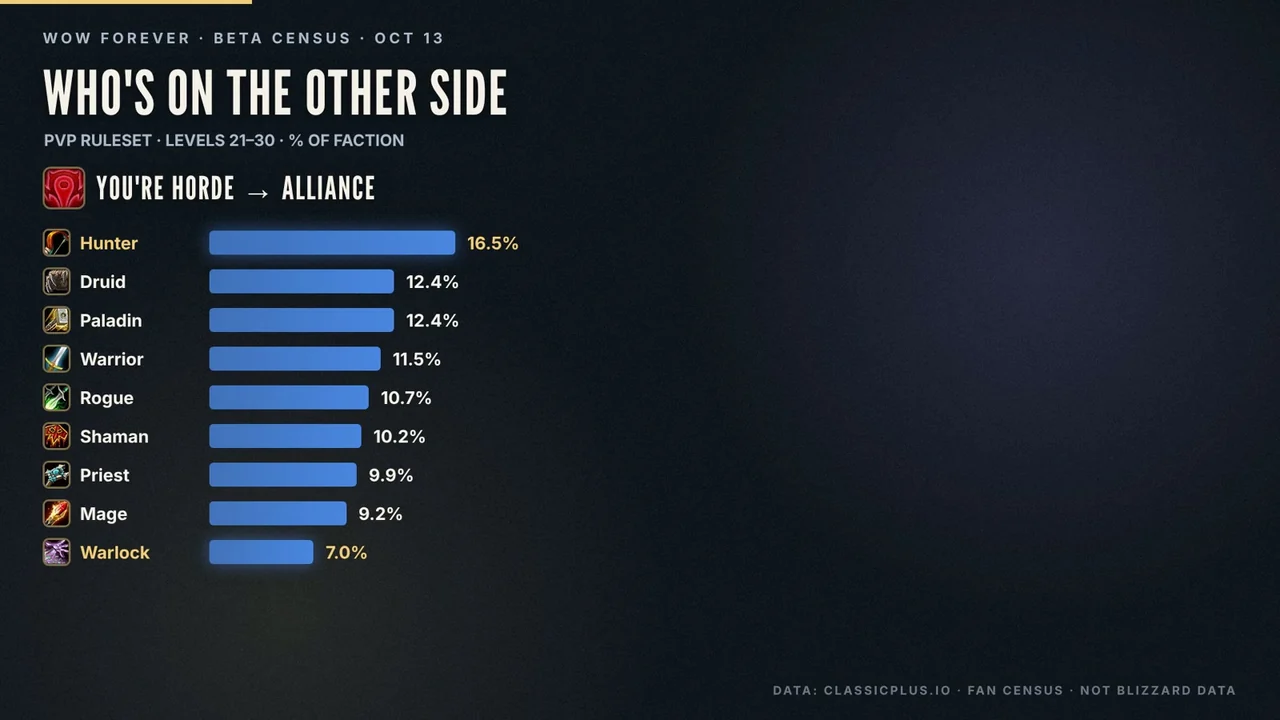
What 1 million beta characters tell us
A dated look at the October 13 fan census: class and race shares, the opposing faction's toolkit, Skyborne's effect and the very different duel sign-up field.